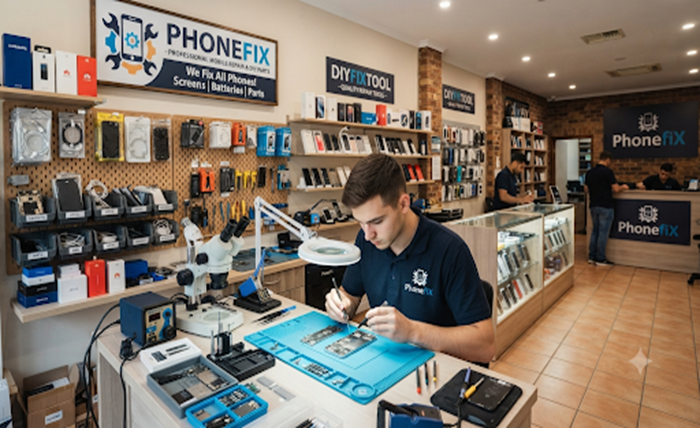
When you examine the number of tools
professional technicians use, starting a phone repair business may appear difficult. But don’t worry— Beginners have no need to buy all of the gear. The basic equipment an in-the-field phone repair kit ought to include is the equipment that can be used for frequently asked repairs like the replacement of screens, batteries, charging-port troubleshooting, and basic troubleshooting.
Modern smart phones are also cleverly designed that are contained in a compact space and mostly feature strong adhesives, minute screws, fragile connectors, and flexible cables as well. The wrong tool could result in a costly error. Hence, one of the initial ideas a newbie should learn is to select the right equipment.
Here is the list of phone repair tools for the do-it-yourselfer that are needed in 2026, as well as the tools which can be added as they expand their abilities.
- Precision Screwdriver Set
The first consideration for the new repair bench is a good precision screwdriver set. Smartphones are fastened with very small screws, and it can be generally found that manufacturers have various screw head types and sizes.
A good set will contain some standard and common Phillips, Torx, pentalobe and other small holders for popular models. Also magnetic tips are beneficial due to their capacity of removing and setting very small screws.
- Plastic Pry Tools and Opening Picks
Once you remove all the screws, you must find a safe method to disassemble the phone. An opening pick is a type of tool used to open doors and windows, particularly where locks are missing or broken.Plastic opening picks and nylon pry tools are used for this.
They can assist in separating frames, back covers and internal components and help minimize the potential for scratching the frame or causing damage to thin components.
- Precision Tweezers
Using tweezers will prove to be really handy when you begin to operate with small connectors, brackets, screws and other internal parts.
A pair of ESD-safe is very useful to those who are handling sensitive electronic components. Straight tweezers can be useful for most tasks while curved and fine point tweezers are best suited for close manipulation.
There is an ideal range of solutions available at the lower, simpler levels, but for technicians heading towards the board level, a more specialised offering is proving to be advantageous.
- Suction Cup
A suction cup is another easy to use item that can be used to make it easier to remove the screen.
It is set with a controlled heat setting combined with the use of the right pick, to provide a small opening between the display and the phone frame. This provides the technician with an access point instead of being forced.
- Heat Pad or Hot Air Tool
Strong adhesive is used on many smartphones to attach screens and the batteries. This glue can be softened by controlled heat, easing disassembly.
Both a heating pad and a hot air tool can offer relatively even heat over a larger area and a hot air tool can provide more targeted heat. Temperature control should be mastered first before beginning to tinker with expensive phones as it can potentially harm displays, batteries, adhesives or other nearby electronics when the heat becomes too extreme.
- Magnetic Repair Mat
The magnets on the repair mat are particularly convenient for newbies as the smartphone accessories are extremely small and hard to locate.
A bigger point is that screws can appear virtually indistinguishable but vary in length. They should be kept in their designated areas in order to avoid possible error in the reassembly process.
- ESD Protection
These static electric fields can damage sensitive electronic parts and are not necessarily visual. Anti-static wrist strap and ESD-safe work surface are therefore good extras for a repair bench.
- Digital Multimeter
After the first few simple part changes, a multimeter is one of the most valuable diagnostics instruments.
It can be used to test the electricity voltage, continuity, resistance and a variety of other electrical conditions. For instance, the technician is not forced to replace a charging component at the first sign of a problem; he or she has the option to take some basic measurements and assess the probable cause of the problem, figuring out whether it actually has to do with the charging circuit or not.
- Soldering Iron and Hot Air Station
These are typically better suited for once you’ve learnt fundamental disassembly and replacement procedures.
A soldering iron is used to solder/desolder, a hot air station may be beneficial with surface mounting parts. These are especially relevant to the upcoming shift by technicians to becoming board level repairers and microsolderers.
- Magnification and Good Lighting
Detailed visual examinations of small parts are challenging. Bright work light plus magnification is a significant difference as connectors, solder joints, flex cables and circuit boards are examined.
Boys who begin repairing equipment can find it to be an investment to get a digital microscope or professional microscope. For easy fixes, however, a good light and a simple magnifying glass might be enough.
What Should Be in a Basic Mobile Phone Repair Tool Kit?
If a small budget is limited, begin with what is fundamental and the building block of a full professional workshop can later be added to it.
A practical Basic mobile phone repair tool kit can include:
- Precision screwdriver set
- Plastic opening picks
- Nylon pry tool or spudger
- Precision tweezers
- Suction cup
- Magnetic repair mat
- Anti-static wrist strap
- Cleaning brush
Isopropyl alcohol and suitable cleaning supplies
Good work light
When you’re comfortable with screen and battery removal, then you can add a multimeter, heating tools, soldering supplies and magnifiers.
Technicians who want to find more Phone Repair Tools can try to focus on special suppliers like DIYFIXTOOL, which can give them mobile repair equipment which has different stages.
What About Phone Unlocking Tools?
Phone unlocking is still another specialized service which is provided with cell repair. Specific machines, software, and networks, as well as the nature of the lock, determine the actual equipment needed.
Legitimate technicians that unlock and/or service supported devices may require special tools and hardware. A novice has to learn the difference between maintenance or repair and “passing on or around” security (without permission).
If unlocking is included with your legal repair services, you may try using some specific Phone Unlocking Tools supplied by suppliers like DIYFIXTOOL.
Final Thoughts
It’s not a quick and easy task to assemble a cell phone repair toolkit. A few stable tools are enough for a beginner and these can be added to in the following stages as their repair projects grow.
A good basic screening of tools is a precision screwdriver set, plastic pry tools, tweezers, suction cup, magnetic mat, ESD protection and good lighting. Having done that, you can then include diagnostic equipment, heating tools, soldering tools and specialty repair machines as you progress to more sophisticated repair jobs.
The number of tools on your bench is not the most important investment. It’s a process of knowing and using the correct tool to repair something, and not incidentally wrecking it, or buying the wrong tool for a repair job. By making the right foundation, it’s possible for beginners to steadily work up to a more effective phone fix workstation in 2026.